
Self-Improvement Ads Are Starting to Diagnose You
Self-improvement advertising used to be easy to recognize: read more books, meditate every day, learn a language, train your brain, become a better version of yourself.
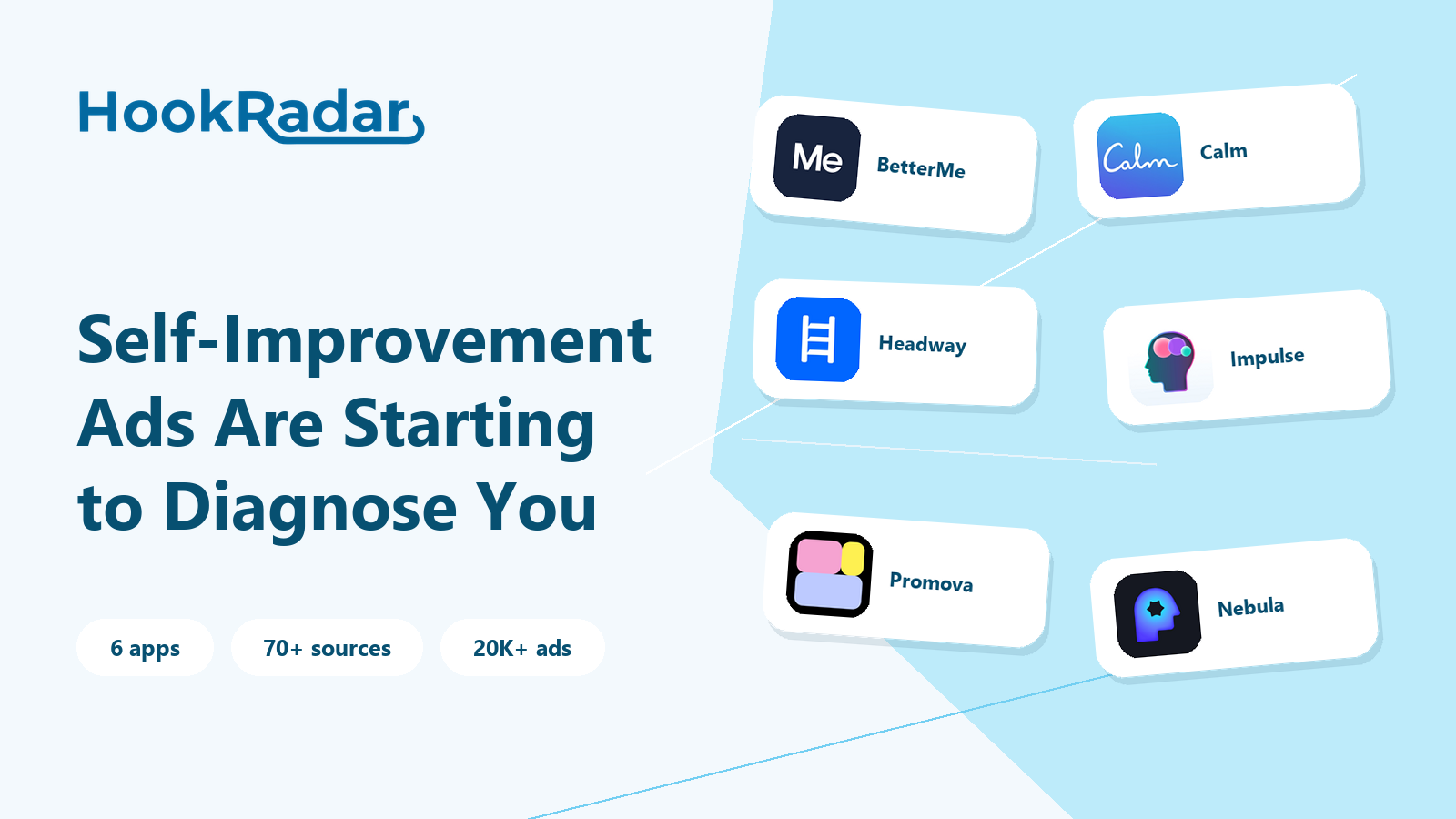
The products have not changed that much. The way they enter the conversation has. HookRadar reviewed current paid ads from BetterMe Mental Health, Calm, Headway, Impulse, Promova, and Nebula, then compared them with fresh TikTok videos around overthinking, anxious relationships, nervous-system regulation, and everyday wellness.
The strongest paid ads are not leading with a feature. They give the viewer a reason for the problem first. TikTok is doing something different: shrinking the same problem into one sentence, one sound, or one useful action.
1. Paid ads are selling the diagnosis before the product
The recurring structure is simple: name a private frustration, replace shame with a more interesting explanation, then offer a quiz, plan, audio exercise, or reveal. The product arrives after the viewer has already learned something about themselves.
This is not a completely new funnel. Quizzes, short daily commitments, and personalized plans are still everywhere. What changed is the first layer: attachment style instead of relationship anxiety, trauma bond instead of low self-esteem, avoidance instead of kindness, lack of rehearsal instead of bad English.
BetterMe: the relationship quiz starts as a confession
BetterMe's stronger relationship creatives do not open with meditation, journaling, or an app screen. This animation begins with two unhappy characters in bed and the line “Constant reassurance wasn't the answer.” It moves through replaying conversations, looking for signs, wanting to leave, and still calling the same person “my favorite person.”
The destination is familiar: a three-minute attachment quiz and personalized plan. The improvement is the packaging. “Discover your attachment style” sounds like a category. “Constant reassurance wasn't the answer” sounds like a thought someone had last night.
A second BetterMe test asks “Am I the problem in our relationship?” over a solitary figure in an empty field. The same media appeared across 22 ads, but the selected launch stopped quickly, so it is better read as a meaningful test cluster than a proven winner.
Calm: remove the shame, then name the mechanism
Calm's sharpest recent example says: “Missing a toxic ex isn't about low self-esteem. It's a trauma bond acting like a literal chemical addiction, keeping the nervous system hostage.”
That sentence validates an embarrassing feeling, replaces a moral failure with a physiological explanation, and creates a reason to try Calm's EMDR-inspired bilateral audio. The execution is almost aggressively simple: white text, a misty lake, calm ambient music. Remove the copy and the creative becomes generic meditation footage.
The signal is stronger than a one-off interesting script. The selected creative is live with an A-grade signal and six ads sharing the same media fingerprint. Calm's wider active set repeats nearby language around bilateral stimulation, body tension, deep rest, breakups, and three-minute resets.
2. Headway is escaping the “book summary app” category
Sell one uncomfortable identity gap
One current Headway creative opens with “Stop being a nice leader,” followed by “Your team doesn't need a friend.” The script moves through sugarcoated feedback, missed deadlines, avoided conflict, and lost authority. Only then does Headway appear as the source of a new operating system.
This is much sharper than “read a book in 15 minutes.” It sells a specific transition: approval-seeking manager to respected leader. Headway can use the same library to build narrow funnels around intimacy, difficult conversations, confidence, money, or management without changing the product.
The useful pattern is not simply using a provocative hook. It is choosing a situation adults feel they should already know how to handle, then positioning microlearning as private rehearsal.
3. Impulse made the personality quiz socially dangerous
A wrong answer now threatens identity
Impulse has used IQ puzzles and focus tests for years. Its newer archetype direction is more socially charged: “Most men swear they are a wolf or panther in the Dangerous Minds tier. Then the results come back and they are sitting in the NPC row next to the pigeon.”
The screen combines a talking head with a tier chart titled “What kind of man are you?” The viewer wants the aspirational identity, dislikes the embarrassing alternative, and has a result they can post in the comments.
This is not only a clever line. The selected asset is live with an A-grade 9.4K signal and appears in 15 ads sharing the same media fingerprint. The old IQ challenge asked whether you were smart. The new version asks whether your self-image survives contact with the result.
4. Promova sells rehearsal for the moment you freeze
The enemy is not English. It is social pressure.
Promova's useful recent direction opens on a work call: “I know the answer. But the moment someone asks me directly in English with everyone watching, something just shuts down.”
The key reframe is: “This isn't about my English. I know English. This is about never having actually practiced the moment.” The visual moves from a frustrated professional to AI role-play under realistic workplace pressure, but without an audience.
Promova currently has a much smaller active body than the other advertisers in this report: 17 active ads versus 1,293 stopped on its main page. AI role-play is therefore a promising test, not a scaled market winner. The strategic idea is still useful: sell practice for the emotionally difficult moment, not mastery of the entire skill.
5. Nebula turns uncertainty into an immediate visual answer
Show enough of the reward to make the quiz feel real
Nebula uses the most literal promise in the group: “This will give you goosebumps. I'll show you your soulmate's face.” The product demonstration is essentially the reward.
The selected video opens with an AI-generated face made from pebbles, moves through reactions, and reveals a drawn soulmate. It was live on day two with a B-grade 7.4K signal, roughly 1,300 EU impressions per day, and 16 ads sharing the same media fingerprint.
That looks like a fast multilingual rollout, but it is still too new to call a long-running winner. The broader lesson is safer: when the output is visual and deeply personal, reveal enough inside the ad that the assessment feels tangible.
6. The paid pattern: give the viewer a better story about the problem
Across six very different products, the strongest openings do the same job. BetterMe names attachment behavior. Calm names a trauma bond. Headway names avoidance. Impulse questions self-image. Promova names a missing rehearsal. Nebula turns romantic uncertainty into a face.
This is more useful than saying “transformation still works.” Of course it does. The creative change is that the transformation is preceded by an explanation that creates relief, curiosity, or mild identity threat before the product demo begins.
7. TikTok is making the same problems smaller and more immediate
The broader TikTok set was collected from current wellness queries rather than official brand accounts. The most useful videos are not generic advice. They reduce a large emotional category to one precise trigger, one sensory experience, or one mechanism worth saving.
The most shareable relationship hook reads like a private message
The full line is: “Just because I overthink doesn't mean I don't trust you. I'm just terrified of losing the one person that's finally made me feel understood.” The visual is only a dark, blurry embrace.
The post reached about 214,000 views in three days with roughly 39.7% measured engagement. The important number is 14,386 shares. The viewer does not need to explain the feeling in a comment; they can send the video to the person it is about.
Paid teams can borrow the precision. Do not open with “relationship anxiety.” Open with the dry text, the unanswered message, or the fear of losing the first person who made you feel understood.
The didgeridoo and ASMR videos do not merely promise calm. They let the viewer sample a calmer sensory state while watching. The fascia video takes a different route: a talking head, anatomical diagrams, and one surprising claim. It reached about 121,000 views in two days and earned roughly 4,850 bookmarks.
Lists still win when every item feels doable tonight
“Things that actually calm your nervous system” lists hugs, physiological sighs, sunset walks, ashwagandha, journaling, and warm lighting in eleven seconds.
There is no grand promise and almost no explanation. The value is six actions that can be scanned, saved, and tried. This is the opposite of a long paid funnel, which is exactly why it is useful to paid teams.
A strong hybrid ad could keep the paid diagnosis, then deliver one immediate action before asking for the click.
8. Five creative tests we would run next
- Replace the category with the trigger. “Left on seen” is stronger than “relationship anxiety.” “Asked a question on a call” is stronger than “language confidence.”
- Let the ad deliver a sample of the outcome. Calm can play a short bilateral-audio moment. Promova can show a real correction. Headway can give one useful line from the difficult conversation.
- Build quiz results for comparison. Impulse's animal chart works because the output can be defended, shared, and argued about.
- Use “not X, but Y” only when Y is more specific and actionable. Not weak, but trauma-bonded. Not bad at English, but unrehearsed. Not nice, but avoiding conflict.
- Make the first three seconds work as an organic post. A confession, surprising mechanism, unusual sound, private question, or visual reveal should earn attention before the product UI arrives.
Final read
The self-improvement market is not becoming gentler. It is becoming more specific. Paid ads win attention by giving the viewer a compelling explanation for why they are stuck. Organic content wins by giving them one sentence, sound, movement, or useful action they can use immediately.
The next strong ad probably sits between the two: keep the sharp explanation, but give the viewer a small piece of relief before asking them to click.
This report is for research, commentary, and market analysis. Brand names, ads, and social posts referenced here belong to their respective owners. Examples are shown as publicly available marketing materials for discussion and critique.
More from HookRadar Digest
- AI Productivity Tools: What Marketers Can Steal From Notion, Monday, ClickUp & ZapierHow workflow platforms sell agents, celebrity partnerships, and operator leverage.
- AI Photo App Marketing in 2026: Winning Ads, Creative Strategy & Viral TrendsInstories, Mojo, Photoroom, Remini, Glam AI, Prequel — what the winning hooks look like now.
- Back to the HookRadar blogEvery week: paid ads, creator content, official social, and organic trend breakdowns.
- Bring HookRadar into your AI tools with MCPHookRadar can plug directly into your AI assistants through MCP, so competitor ads, organic posts, and creative signals join your own research workflows.